

If a company enters a payment amount in UAH instead of thousands of UAH, a discrepancy a thousand times greater arises during reconciliation. Formally, the data from the company and the government body may differ by almost 100,000 %, although the reason lies not in non-payment but in the incorrect choice of unit of measurement.
This is one of the practical errors discussed on 22 July during the online training session “Payment Reporting to the State: New Opportunities of the Ukrainian EITI Portal — 7.0.” The event was organised by the
NGO“NOVA Energiya” for companies in the extractive sector and those involved in the transportation of oil and gas.
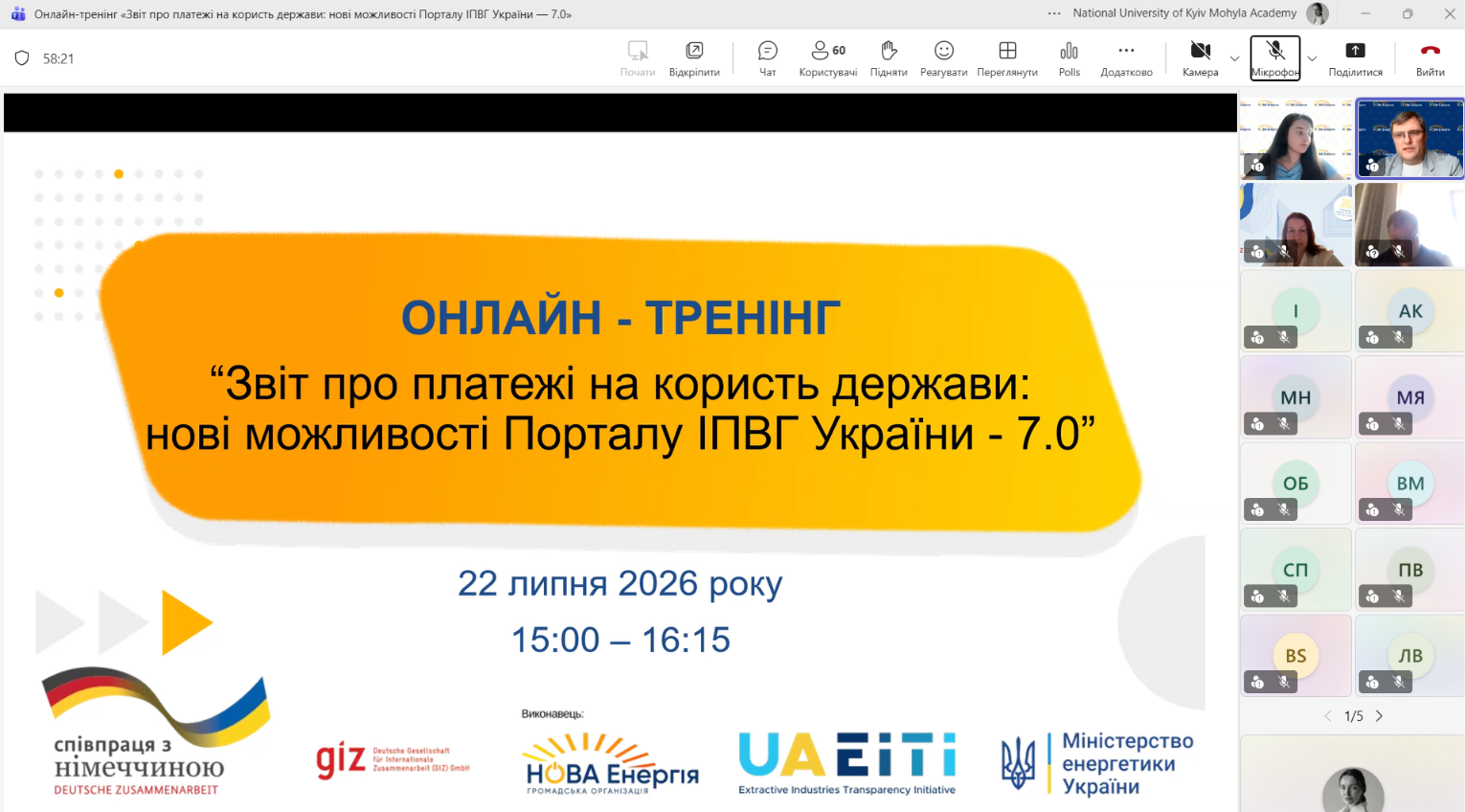
Almost 100 participants registered for the training session. More than half of them work in the fields of accounting, finance, economics, tax accounting, auditing and IFRS. Lawyers, geologists, environmentalists, specialists in subsoil use and company directors also took part in the training.
Participants’ queries related to specific work situations: how to add an organisation to their account, restore the ability to sign a report, record specific expenses for the benefit of state institutions, reconcile EITI data with other types of corporate reporting, and seek advice in the event of a follow-up enquiry.
What has changed on the Portal
As part of the EITI Portal update, 38 forms were revised and 24 new ones were created. The changes covered not only the interface but also the data structure, reference guides, mandatory fields, information on payments, project activities, ultimate beneficial owners, social programmes and public sector enterprises.
Vitalii Fylenko, Executive Director of the NGO “NOVA Energiya”, explained which companies are subject to reporting requirements, how the logic behind the submission of information is structured, and what to look out for when completing the updated forms.
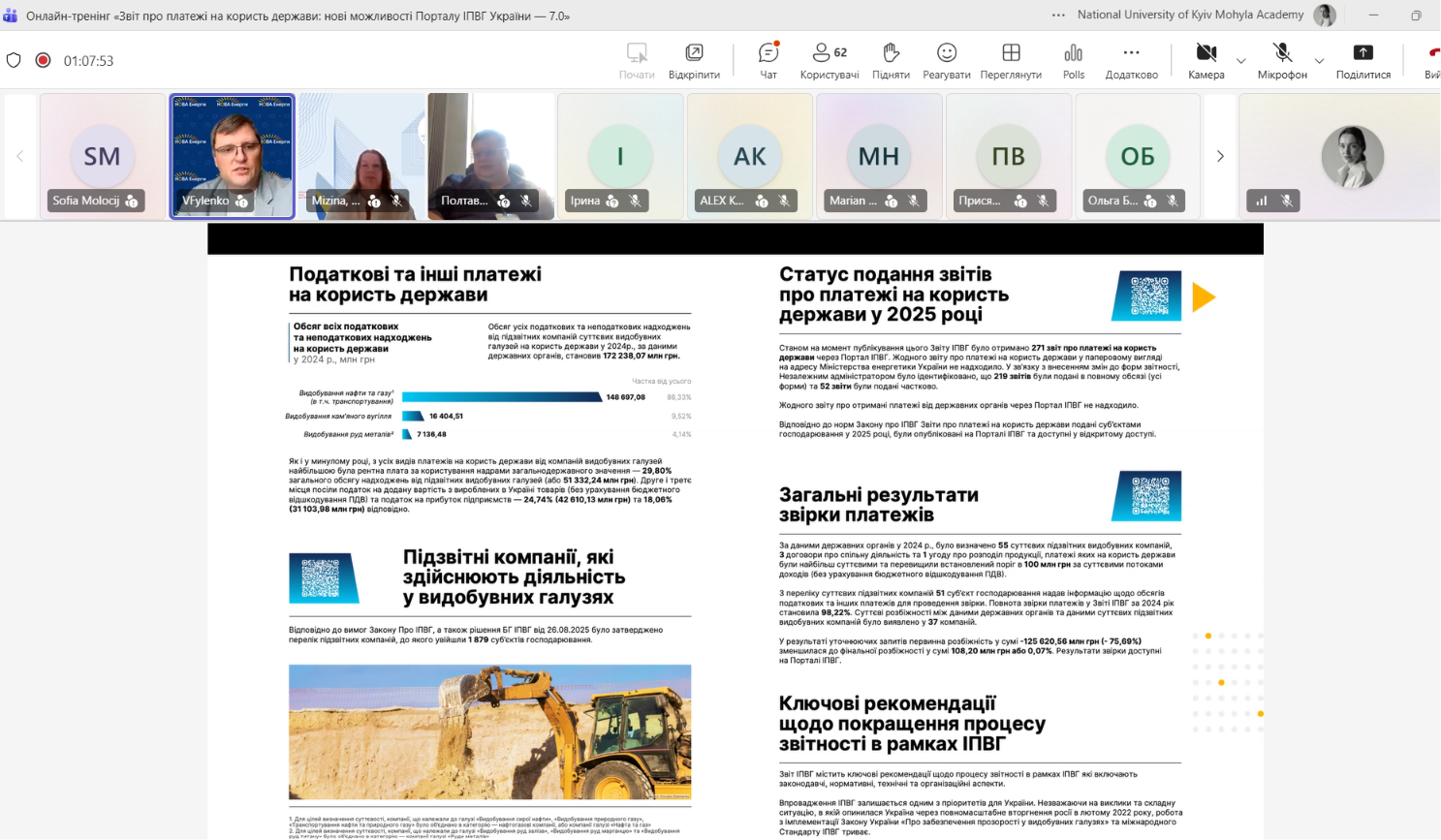
One of the key requirements is consistency of data across different sections. Information on special permits must correspond to the data on project activities, production, mineral reserves, rent payments, land fees, and environmental tax. If related forms contain different data, the company receives additional requests and the reconciliation process takes longer.
Mykola Sytnyk, CISO of the EITI Portal, demonstrated practical changes in the user account. Before starting the reporting process, companies need to verify their account details, separate units, and relationships between parent and subsidiary companies. This information is automatically used in other forms, during payment reconciliation, and when generating a consolidated report.
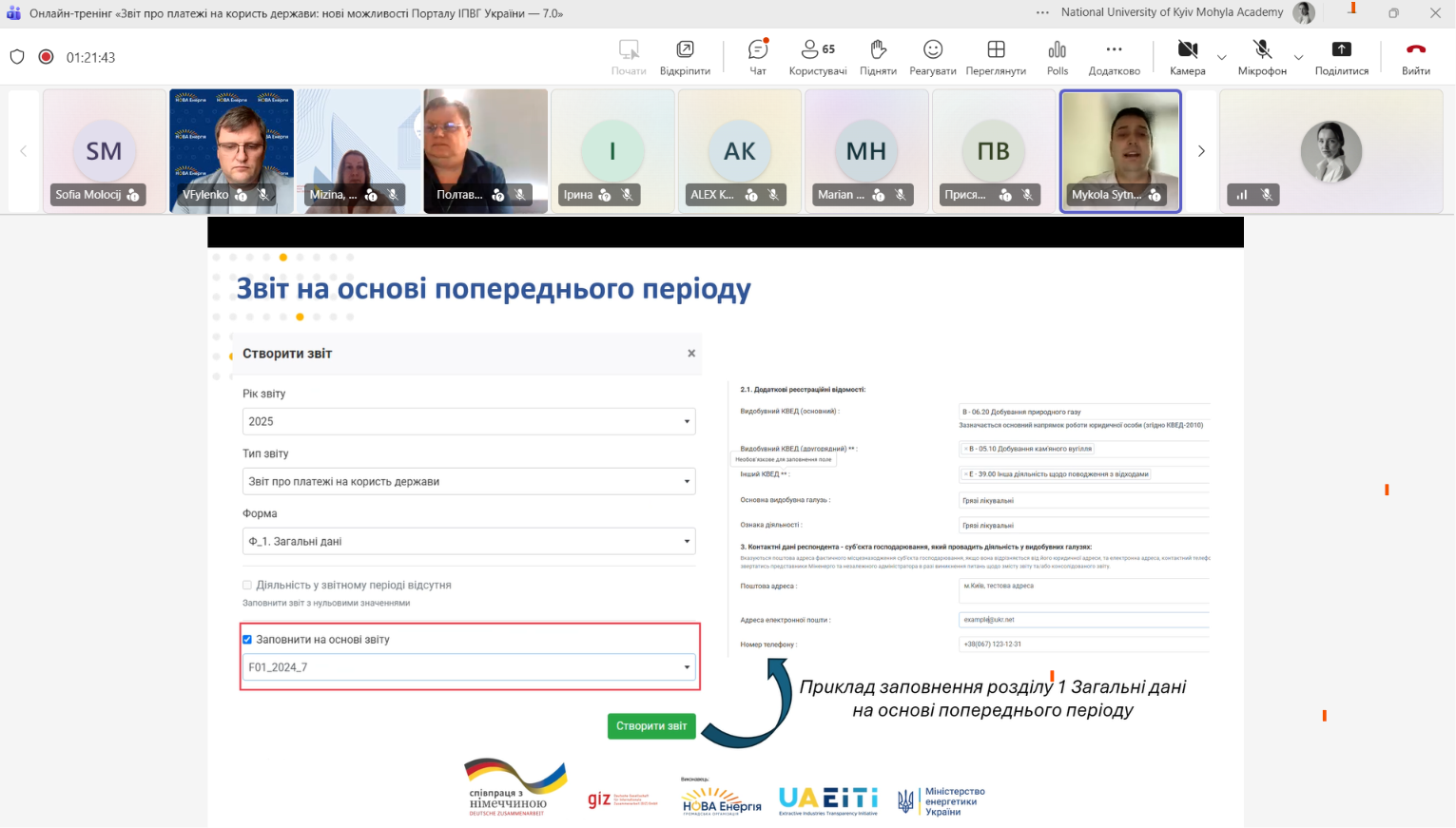
Participants were also shown how to create a report based on the previous reporting period, check sections for errors, sign several drafts, and download completed forms. At the same time, XLSX file import is not available for all sections: forms with a complex structure must be completed directly on the Portal.
Errors That Affect Data Quality
In addition to incorrect units of measurement, reconciliation regularly reveals incorrect payment codes, duplicated data, excessive rounding of amounts, incomplete information on special permits, and discrepancies between related forms.
Particular attention was paid to the “Notes” field. It should be used to explain the exchange rate applied, changes to the KATOTTG code, specific payment calculation methods, or reasons for a missing indicator. Such an explanation makes it possible to correctly interpret the data without additional correspondence with the company.
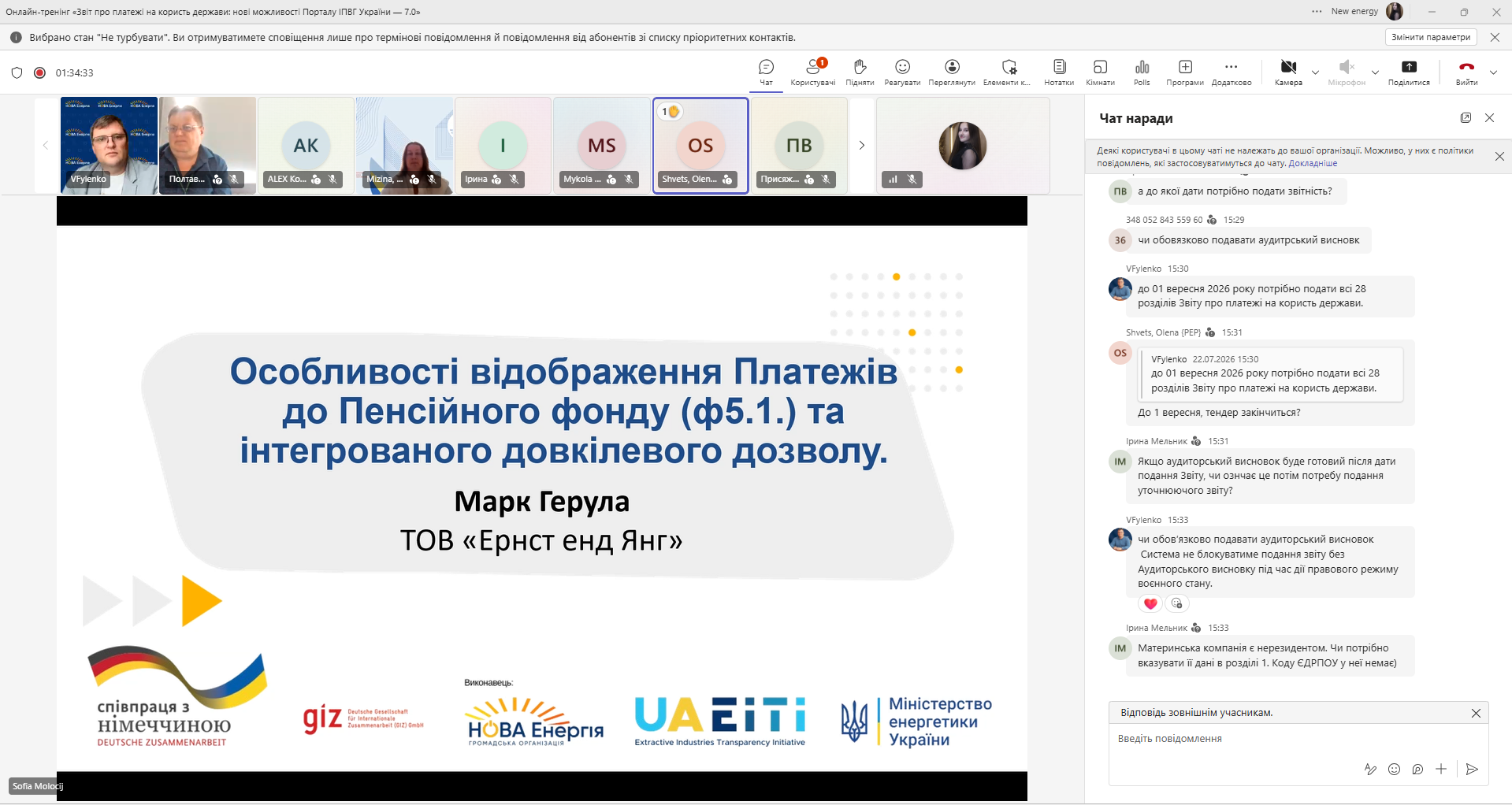
Mark Gerula, a representative of Ernst & Young LLC, discussed special reporting cases, including joint activity agreements, production sharing agreements, the transfer or cancellation of a special permit, payments to the Pension Fund, and fees for the issuance of an integrated environmental permit.
Companies were also advised to report payments separately for each community within the area covered by the special permit, indicating the relevant KATOTTG code. If no activities under the permit were carried out during the reporting period, the fields should not be left blank — zero should be entered instead. This makes it possible to distinguish confirmed absence of payments from missing data.
The full Payment Report to the State consists of 28 forms, while the Consolidated Report consists of 29 forms. The system assigns the “Submitted” status only after the entire required package has been completed. Signing individual sections does not mean that the reporting process has been completed.
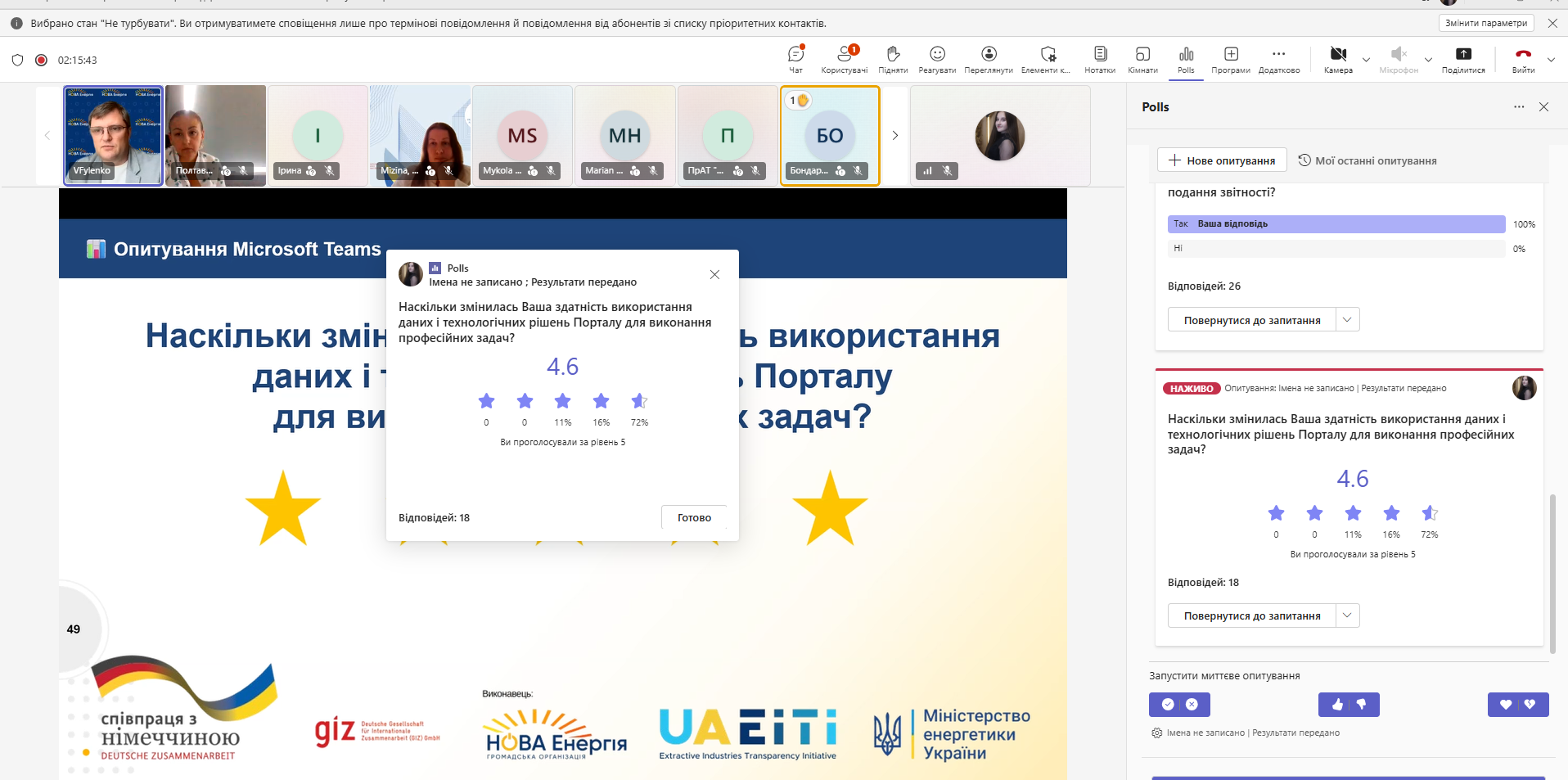
The practical value of the training was confirmed by the participants’ final survey. On a five-point scale, participants rated the improvement in their ability to use the EITI Portal’s data and technological solutions to perform their professional tasks at an average of 4.6 points.
72% of respondents gave the maximum score of 5, while another 16% gave a score of 4. This indicates that participants gained not only an understanding of the updated requirements but also practical skills in working with the Portal.
The EITI Portal is an example of a GovTech solution, but its public value emerges only when data become understandable, accessible for analysis, and suitable for use by government, business, media, experts, and communities.
That is why the “Effective Governance through GovTech and Transparency in Ukraine” project supports not only the development of digital tools but also user-oriented solutions for transparent and inclusive recovery. The official project description by GIZ specifically emphasizes cooperation between public administration and civil society in developing such solutions.
Technology creates an opportunity for transparency. However, turning it into a real accountability mechanism is possible only through high-quality data, competent users, and continuous interaction between government, business, and civil society.
For those who would like to learn more about the updated capabilities of the EITI Portal, the requirements for completing the forms, and practical recommendations for preparing reports, the presentation from the online training is available below.
This material was prepared by the NGO “NOVA Energiya” as part of the implementation of the project “Supporting the Implementation of the EITI Portal to Ensure Transparency of the Extractive Sector Recovery and Energy Transition in Ukraine (EITI4RESETUA),” implemented with the support of the “Effective Governance through GovTech and Transparency in Ukraine” project, implemented by the Deutsche Gesellschaft für Internationale Zusammenarbeit (GIZ) GmbH with the support of the Government of Germany.

